Venezuela Sets the Stage for Political Dialogue
Venezuela's interim government has announced plans to commence formal discussions with certain opposition factions, starting on August 1. This development marks a significant step following the controversial removal of Nicolás Maduro from power, which occurred over six months ago during a U.S.-led operation in Caracas. Maduro was subsequently taken to New York to face charges related to drug trafficking.
Current Political Leadership
In the wake of Maduro's arrest, Delcy Rodríguez, a former vice-president and Maduro ally, assumed leadership with the support of the Trump administration. This transition has been met with discontent from opposition groups who anticipated a more substantial governmental shift post-Maduro.
The talks aim to establish a "route map towards democracy," as stated by the opposition. This initiative was revealed through coordinated announcements by opposition representatives and Jorge Rodríguez, who leads the government-controlled National Assembly and is Delcy Rodríguez's brother.
Reason for the Talks
Jorge Rodríguez attributed the motivation for these talks to the aftermath of two devastating earthquakes that struck northern Venezuela on June 24, causing significant loss of life and structural damage. He emphasized the necessity of unity for reconstruction and maintaining peace.
The opposition's statement highlighted the United States' assistance post-earthquake, reinforcing the notion that "Venezuela is not alone."
Composition and Goals of the Opposition
The opposition delegation is primarily composed of former lawmakers elected in 2015, which was the last instance when opposition parties held a majority in the National Assembly. Subsequent elections have faced boycotts and allegations of unfair practices, consolidating power within Maduro's party.
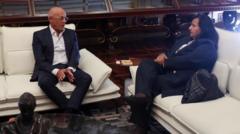
Dinorah Figuera, who recently returned to Venezuela after years in exile, will lead the opposition team. Her return was facilitated by an invitation from the U.S. State Department, aiming to advocate for the renewal of the National Electoral Council (CNE), which has been criticized for its pro-government bias.
Focus of the Negotiations
The opposition has outlined that the primary focus of these talks will be strengthening democratic institutions, ensuring fair electoral processes, and securing political participation guarantees. Despite the release of numerous political prisoners following Maduro's ouster, many remain incarcerated, highlighting ongoing challenges for critics of the Maduro regime.
Opposition Leadership Dynamics
Among the opposition, María Corina Machado remains a notable figure despite her absence from Venezuela since receiving the Nobel Peace Prize for her efforts in promoting democracy. Although initially supported by the U.S., recent indications suggest a shift in preference towards Dinorah Figuera as a key negotiator for democratic transition.
Machado attempted to return to Venezuela after the earthquakes but was unsuccessful. While President Trump denied blocking her entry, reports suggested her return could disrupt post-disaster recovery efforts. Machado has not publicly commented on the upcoming talks but is expected to discuss them with her coalition soon.
Source: Original Article