Renewed Hostilities in the Gulf
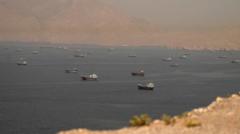
Military tensions have reignited between the United States and Iran in the Gulf region following attacks on oil tankers in the Strait of Hormuz. On Tuesday, the US Central Command (Centcom) announced the execution of substantial military strikes targeting over 80 sites in Iran. This action was in response to the attacks on three tankers, for which Iran has not claimed responsibility.
Iran's Retaliation
In response to the US strikes, Iran declared on Wednesday that it had targeted American military installations in Bahrain and Kuwait. The Iranian Revolutionary Guard Corps (IRGC) confirmed that missiles and drones were launched at 85 key US military facilities, including a US Navy headquarters and an air base located in Kuwait. The strikes by Iran prompted a swift condemnation from Kuwait, which criticized the repeated attacks on its territory.
International Reactions
NATO's secretary-general, Mark Rutte, justified the US strikes during a military alliance summit held in Ankara, Turkey. Rutte described the American response as "absolutely necessary," claiming that Iran's actions constituted a breach of a ceasefire due to the tanker attacks.
Meanwhile, Iran's parliamentary speaker, Mohammad Bagher Ghalibaf, accused the United States of violating a Memorandum of Understanding (MoU) by reinstating oil sanctions and carrying out military strikes. Ghalibaf emphasized that Iran would not succumb to external pressure.
Memorandum of Understanding Breached
The US Treasury's decision to revoke a waiver that temporarily lifted oil sanctions on Iran was seen as a breach of the MoU signed between Washington and Tehran last month. Iran's foreign ministry criticized this move, calling it evidence of the US's inconsistency and unreliability. Tehran reiterated its commitment to protecting its national interests and security.
Regional Impact
The conflict has also drawn reactions from regional players. Both Qatar and Saudi Arabia condemned the attacks on tankers from their respective countries and attributed blame to Iran. Qatar's foreign ministry held Iran "fully responsible" for an attack on the Al-Rekayyat vessel, while Saudi Arabia accused Iran of targeting its tanker, Wadyan.
Iran, however, rejected these accusations. Its foreign ministry spokesman, Esmail Baghaei, argued that such claims were "contrary to the principle of good neighbourliness" and insisted that uncoordinated commercial vessel routes or tampering with tracking systems could lead to unforeseen incidents.
Ongoing Negotiations
Despite the exchange of military actions, US officials have reiterated their commitment to pursuing a diplomatic resolution with Iran. Last month, both nations agreed to a 14-point memorandum aimed at extending a ceasefire and resolving conflicts. The agreement also called for discussions between Iran and Oman, alongside other Gulf states, to define the administration and maritime services in the strategically vital Strait of Hormuz.
According to Iranian media, the new arrangement could eventually see the strait managed by Iran, in coordination with Oman, potentially involving service fees for ships passing through this crucial waterway.
Source: Original Article