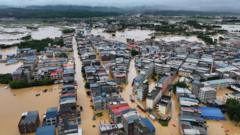
Typhoon Maysak Brings Devastation to Southern China
Heavy rainfall began pounding Renhe village in Guangxi province, southern China, on a Sunday, leading to severe flooding that quickly escalated to knee-deep levels by early Monday morning. The first floors of homes were submerged by dawn, leaving residents, including a woman known by the surname Zhou, without time to gather essentials before evacuating. Zhou's family is among the tens of thousands displaced as Typhoon Maysak swept through the area, causing rivers to overflow and dam walls to collapse.
At least four fatalities have been reported. The city of Nanning and its surrounding areas have been particularly affected, with residents seeking rescue from their rooftops. The storm's impact extended to the central province of Hubei, where thunderstorms and tornadoes were reported, resulting in 17 deaths, numerous injuries, and the evacuation of tens of thousands, according to state media.
President Xi Orders Comprehensive Relief Effort
The widespread destruction prompted President Xi Jinping to call for extensive rescue and relief operations. Typhoons are not uncommon in China during this season, and Maysak is the first to strike the country in 2026. Characterized by its sudden onset and intense winds, the storm's effects are exacerbated by the impending arrival of Super Typhoon Bavi, which is forecasted to hit China's eastern coast soon.
Authorities in Nanning have cautioned that further heavy rainfall could impede ongoing rescue efforts. The increasing frequency of extreme weather events, linked by experts to climate change, poses significant challenges to China's population and economy, particularly its agriculture sector.
Residents Struggle Amidst Widespread Displacement
In Guangxi province, thousands find themselves trapped on rooftops in rural areas due to the flooding. Official figures suggest that approximately 60,000 people have been evacuated, with 90,000 affected overall. Zhou, now residing in another province, reports that some of her relatives remain stranded in Renhe with limited food supplies. Her infant niece has gone over a day without milk.
Another resident, Huang, from Yunbiao town, recounts how quickly the floods submerged local villages. The lack of adequate rescue personnel and resources has hampered efforts to save everyone in time. Many have lost communication with their families due to power outages and internet disruptions.
State media broadcasts show rescue teams operating in life vests and helmets, using inflatable boats to reach stranded individuals. President Xi has emphasized the necessity of effective treatment for the injured and the resettlement of affected residents.
Tornadoes Add to the Chaos
Meanwhile, Hubei province has witnessed the formation of at least two tornadoes, a rare occurrence in the region. These tornadoes, generated by the clash of cold northern air with Typhoon Maysak's warm southern air, have caused significant damage in cities like Ezhou and Huanggang.
Social media videos capture the chaos, with footage of furniture and debris being hurled by strong winds. A man in Huanggang suffered injuries after being swept out of his apartment by the forceful winds and is currently in intensive care. A student from the area described the event as a shock, noting the extent of damage only after the winds subsided.
Challenges Persist Across Affected Regions
Other parts of northern China have also experienced extreme weather conditions. In Tongliao city, Inner Mongolia, flash floods claimed the lives of two cattle farmers, while record rainfall led to three deaths in Fushun city.
As rescue operations continue, residents anxiously await news of their loved ones. Zhou has enlisted a friend to check on her family in Renhe, but communication remains difficult. Another woman, worried about her parents in Gantang town, has been unable to reach them since the water levels rose.
Source: Original Article