Dock Workers Demand Reduced Hours in Response to AI Adoption
Australian dock workers are advocating for a reduction in their work week to 28 hours, without any decrease in pay. This demand comes in response to the increasing integration of artificial intelligence (AI) and automation in ports across the nation.
The Role of DP World in AI Implementation
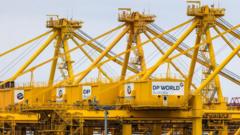
The call for reduced hours is directed at DP World, a major player in port logistics that manages approximately 40% of Australia's container shipments. The Maritime Union of Australia (MUA) has expressed concerns about the impact of AI on job security, stating that the technological shift puts workers' livelihoods at risk.
In a statement, the union remarked, "If DP World wants AI and automation, then they must pay the social dividend. The new technology doesn’t have to cost our members their jobs or put their livelihoods at risk just so a terminal operator can boost profits." The BBC has reached out to both DP World and the MUA for comments and further information.
Impact of AI on Employment
A study by the Centre For International Corporate Tax Accountability and Research, commissioned by the MUA, highlights DP World's growing use of AI tools to manage workforce operations. This trend, according to the study, is part of a broader move to integrate AI without sufficient consultation with employees, potentially threatening up to a thousand jobs, or over 60% of the dock and maintenance workforce.
The company has proposed the implementation of AI-assisted remote-control cranes and autonomous vehicles. The union insists that technology should enhance workers' lives rather than jeopardize them, reinforcing their demand for a reduced work week.
Current Work Conditions and Global Operations
Currently, DP World dock workers are reported to work between 32 to 35 hours weekly, depending on their location, as per the Australian Financial Review. DP World, one of the world's largest port operators, is owned by the state and ultimately under the leadership of Dubai's ruler, Sheikh Mohammed bin Rashid Al Maktoum.
In Australia, the company operates ports in major cities like Sydney and Melbourne, handling millions of shipping containers annually. Globally, DP World operates in 84 countries with a workforce of over 126,000, managing around 10% of the world's container traffic.
AI: An Essential Tool for Modern Supply Chains
Last year, Glen Hilton, DP World's Asia Pacific chief executive, emphasized the necessity of AI in managing increasingly complex supply chains across the region. He stated that the use of AI is "no longer optional" but crucial for efficient operations.
The integration of AI in the logistics and shipping industry continues to shape the future of work, prompting discussions between labor organizations and companies to find a balance between technological advancement and job security.
Source: Original Article